


How to Choose the Right Suspension for Your 4WD: A Guide
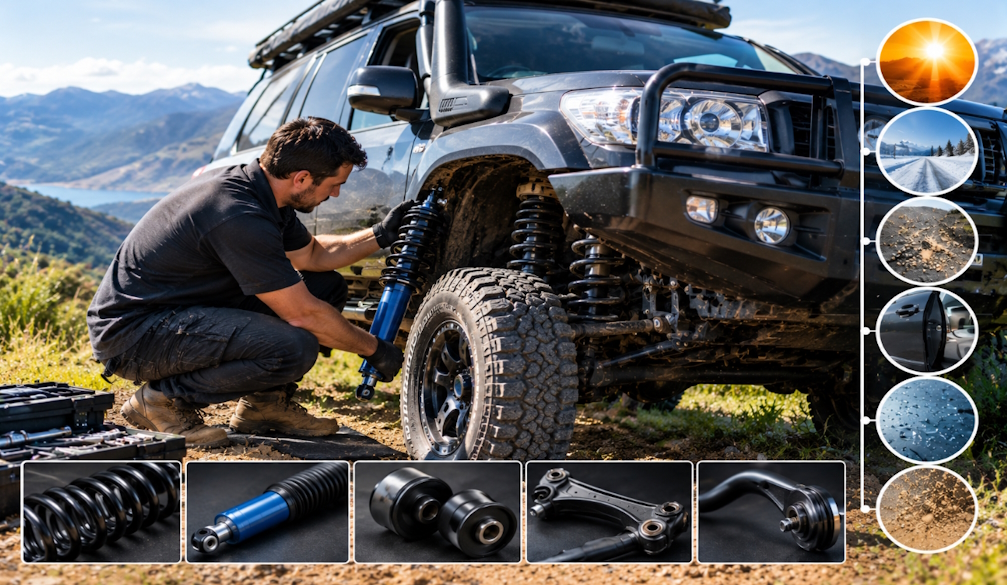
The right suspension for a 4WD depends on how the vehicle is actually used: the weight it carries, the terrain it covers and how often it tows or tours. Choosing on lift height or brand name alone is the most common reason owners end up with a vehicle that rides harshly, sags under load or wears tyres unevenly. It explains what to work out before buying, how the main components fit together, and which mistakes to avoid.
Start With How You Use the Vehicle
Suspension is a compromise between comfort, load capacity and off-road ability, so the first step is being honest about your usage.
- Mostly daily driving with occasional trips: a quality standard-height replacement or a mild upgrade is usually enough.
- Regular touring with gear, water and fuel: heavier-duty springs matched to quality shock absorbers are worth the investment.
- Frequent towing: the rear suspension carries extra weight, so it needs particular attention.
- Rough tracks and corrugations: shock absorbers that resist heat build-up matter as much as the springs.
Know Your Real Load
Weigh the vehicle as you actually travel, with passengers, fuel, water and camping gear. Then add permanent accessories such as a bull bar, winch, drawers, roof rack and long-range fuel tank. These items add weight over the front and rear axles that the original suspension was never specified for.
A suspension upgrade improves how a vehicle handles weight, but it does not change the legal Gross Vehicle Mass (GVM). Raising GVM requires a certified modification process, and the rules vary by state, so check with a certifier before assuming a kit increases your legal payload.
Know the Main Components
Most 4WD suspension setups combine the following parts.
- Springs: coil, leaf or torsion bar, depending on the vehicle. They carry the weight and set ride height.
- Shock absorbers: they control how quickly the springs move. Monotube shocks generally manage heat better on long rough runs, while twin-tube shocks are typically more affordable and comfortable for lighter use.
- Bushings: rubber or polyurethane mounts that wear with age and allow unwanted movement.
- Supporting components: sway bars, control arms and steering dampers, which affect stability and handling.
Springs, shocks, bushings and other 4WD suspension parts should be chosen as a matched set. A heavy-duty spring paired with a light-duty shock will feel bouncy, and a firm shock on a soft spring will ride harshly.
Springs and Shocks Must Work as a Pair
Springs support the vehicle's weight. Shocks control how that weight moves. If the two aren't matched to the load, the vehicle either wallows through corners and over dips or crashes over bumps.
When comparing options, look for spring rates and shock valving specified for your actual load, not just a generic "heavy-duty" label. Adjustable shocks can help if your load changes between trips.
How Much Lift Do You Need?
Lift is often the first thing people consider, but it should follow from what the vehicle needs, not the other way around. A modest lift, commonly around 40 to 50 mm, usually provides tyre clearance and offsets the weight of accessories without disturbing the vehicle's geometry.
Larger lifts change driveline angles and can stress CV joints, brake lines and steering components, which may require additional correction parts. Lift height and tyre size are also regulated, and limits differ between states, so confirm the local requirements before fitting.
Choosing Suspension for a LandCruiser
LandCruisers vary widely between models, so the correct setup depends on the series. A 70 Series with a loaded tray or canopy puts heavy, constant weight over the rear leaf springs, while a 200 Series with independent front suspension responds differently to front-end accessories like a winch and bar.
When comparing LandCruiser suspension kits, check that the kit is specified for your exact model, engine and accessory weight. A diesel wagon carrying a bull bar, winch and dual batteries needs very different front springs from a base model with no additions.
Which Setup Suits Which Use
|
Setup |
Best Suited For |
Consideration |
|
Standard-spec replacement |
Daily driving, light loads |
Lowest cost, no added capability |
|
Heavy-duty springs with matched shocks |
Touring, towing, permanent accessories |
Slightly firmer unladen ride |
|
Air assist helper bags |
Occasional heavy loads or towing |
Assists the rear only and does not raise GVM |
|
Full lift kit with matched shocks |
Larger tyres, rough terrain, heavy use |
Check driveline angles and state rules |
Common Mistakes to Avoid
- Buying by lift height alone. Load capacity and shock quality matter more than how much taller the vehicle sits.
- Replacing only the shocks or only the springs. The two need to work together.
- Ignoring worn bushings. New springs and shocks won't feel right on tired mounts.
- Skipping the wheel alignment. Any change in ride height alters alignment, so it should be checked after fitting.
- Assuming a kit raises legal payload. Suspension improves handling of weight but doesn't change GVM.
Before You Buy: A Quick Checklist
- Weigh the vehicle fully loaded for a typical trip.
- List permanent accessories and their approximate weights.
- Decide how much time is spent on-road, towing and off-road.
- Choose springs and shocks specified for your model and load.
- Book a wheel alignment after fitting.
Frequently Asked Questions
How long does 4WD suspension last? It depends on use, load and terrain. Shocks commonly need replacing before springs, and regular inspection for leaks, sagging and uneven tyre wear is more reliable than relying on a fixed distance.
Do I need to lift my 4WD to upgrade the suspension? No. An upgrade can be set at standard height. Lift is only needed for larger tyres or extra clearance.
Will new suspension increase how much I can legally carry? No. Suspension handles the load better, but the legal GVM only changes through a certified upgrade process.
Should I replace springs and shocks at the same time? Usually yes. Matching them ensures the vehicle rides and handles as intended and avoids one worn part undermining the other.
Can I fit a suspension kit myself? Some owners do, but the work involves compressed springs and safety-critical components. A professional fit followed by a wheel alignment is the safer choice.
Final Thoughts
The right suspension comes from matching the setup to your vehicle's real load, your terrain and your legal requirements, rather than chasing height or a brand name. Get the springs and shocks working as a pair, check the supporting components, and confirm alignment after fitting. Done properly, a suspension upgrade improves comfort, control and long-term reliability on every trip.
