
GEO vs SEO: How to Get Recommended by ChatGPT, Gemini and AI Overviews
- Written by: Auzzi Shopping
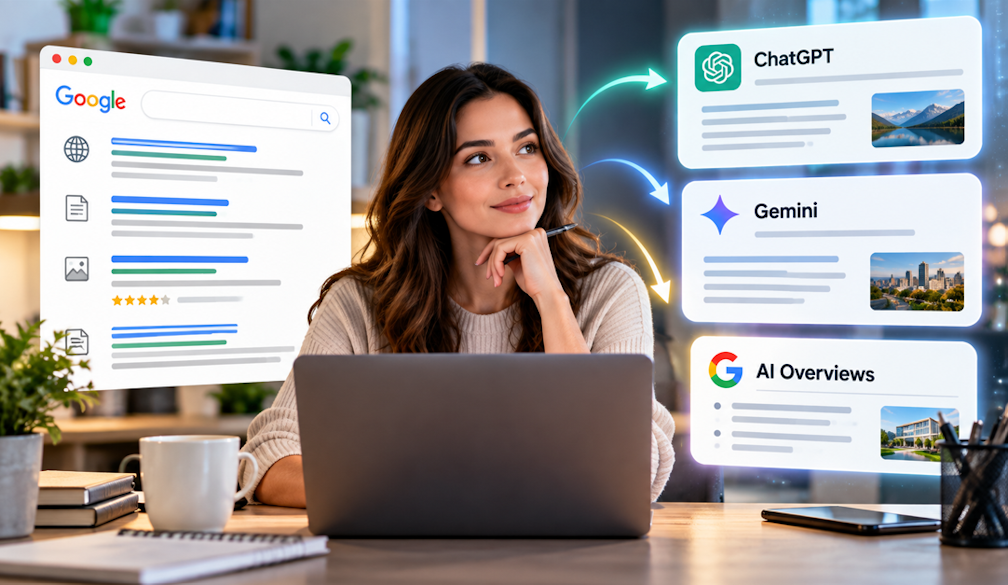
There's a new acronym doing the rounds in marketing circles, and it's causing more confusion than it should. GEO. Generative Engine Optimisation. Some people are calling it AEO (Answer Engine Optimisation) instead, and honestly the naming battle isn't settled yet. What matters is what it actually means for your business, not what letters end up sticking.
Let's cut through it plainly. SEO is about ranking. GEO is about getting mentioned. Those sound similar but they're not the same game, and treating them as identical is how a lot of businesses are going to waste the next two years.
Ranking versus recommending
When Google ranks your page, it's slotting you into a list. Users scroll, compare, click around, form their own opinion. Your job as a marketer has always been to earn a high enough position that people actually see you before they get bored and leave.
When ChatGPT or Gemini or an AI Overview answers a question, there's no scrolling. It picks, at most, a handful of businesses or sources, and it presents them as an already digested answer. You're not competing for position ten versus position one anymore. You're competing for one of maybe three slots in a paragraph, or you're not mentioned at all.
That's a much higher stakes game with a much smaller playing field. And it runs on different fuel.
What GEO actually rewards
Traditional SEO leans heavily on keywords, backlinks, and technical site health. Those things still matter, they're not obsolete, GEO builds right on top of them. But generative engines add a few extra ingredients into the mix that classic SEO never had to worry about as heavily.
Clarity of answer. If your page buries the actual answer to a question under three paragraphs of preamble, a language model has to work harder to extract it, and it might just grab a competitor's cleaner explanation instead. Content that states things plainly, in the first sentence or two of a section, tends to get pulled into AI answers more often.
Entity consistency. This is a fancy way of saying the model needs to be confident about who you are and what you do, based on how consistently that shows up across the web. Wikipedia style clarity, consistent naming, clear business categorisation, all of it helps a model build a confident internal picture of your brand.
Citation worthy structure. Original data, specific numbers, direct quotes from real people, these get picked up and repeated far more than generic marketing copy. If your content says "we help businesses grow" with zero specifics, there's nothing there for a model to actually cite. If it says "we increased organic leads by 40 percent for a client in six months, here's how," that's something concrete a model can pull from and attribute to you.
Trust signals beyond your own site. Reviews, mentions on respected third party sites, directory listings, industry recognition. These act like character witnesses. A model has learned, through training, which kinds of sources tend to be reliable, and mentions on those kinds of sources rub off on you.
Where people get this wrong
The most common mistake right now is treating GEO as a checklist you bolt onto existing content. Add some FAQ schema, throw in a few extra headers, call it done. That misses the point entirely.
GEO is less about tricking a model and more about being the kind of source a model would naturally want to cite anyway. Think about how you'd explain your business to a smart, skeptical friend who's never heard of you and wants a straight answer, not a sales pitch. That's roughly the tone that performs best, because it's the tone that reads as trustworthy to a model trained on huge amounts of genuinely useful writing.
The other mistake is assuming this replaces SEO work entirely. It doesn't. Most of what shows up in AI answers still traces back, at some level, to content that also ranks reasonably well in traditional search. GEO is additive. Skipping foundational SEO and jumping straight to "AI optimisation" tends to produce content with nothing solid underneath it.
A practical starting point
Pick your five most important service pages. For each one, ask a blunt question. If someone typed the exact query this page answers into ChatGPT, would this page give the model everything it needs to write a confident, specific answer? Not vague reassurance, actual specifics: pricing ranges, process steps, results, differentiators stated in plain language.
Rewrite the ones that fail that test. Lead with the answer, not the throat clearing. Add real numbers where you have them. Structure content with clear subheadings that mirror how people actually phrase questions.
Then look outward. Are your reviews thin? Get more, and encourage detail, not just stars. Are you missing from relevant directories or industry lists? Fix that. None of this is glamorous work, but it's the stuff that actually moves the needle, unlike a lot of the noise currently floating around the GEO conversation.
Teams that want a properly built out framework for this, including how it plugs into Google's AI Overviews specifically, might find it useful to look at how Multimediax structures its own SEO approach around both traditional rankings and AI visibility side by side.
Where this is heading
Nobody has a crystal ball on exactly how these AI platforms will evolve their citation behaviour over the next couple of years. But the direction of travel is pretty clear. More queries are being answered directly by models rather than routed through a list of links, and that trend isn't reversing.
Businesses that start building genuine authority now, the kind that shows up consistently across their own site and the wider web, are going to have a real head start. The ones waiting for a settled playbook before they act are going to be playing catch up against competitors who just started doing the obvious things sooner.
If you're not sure where your brand currently stands in AI generated answers, Multimediax’s podcast runs exactly this kind of visibility check for clients, comparing how a business shows up across ChatGPT, Gemini, and Google's AI tools against its actual competitors. Worth knowing where you stand before you start optimising blind.
GEO isn't a replacement for SEO. It's SEO's more demanding older sibling, and it's already sitting at the table.
One final thought worth sitting with. A lot of the anxiety around GEO comes from treating it as an entirely foreign discipline that requires starting from scratch. It doesn't. If you've been doing genuinely good SEO work, clear content, real expertise, honest reviews, decent technical foundations, you're already most of the way there. What GEO really asks is that you stop hiding your best material behind vague marketing language and start saying things plainly enough that a machine, and honestly most humans too, can actually use what you've written.