

Swim with Whale Sharks at Ningaloo Reef: What the Experience Is Really Like
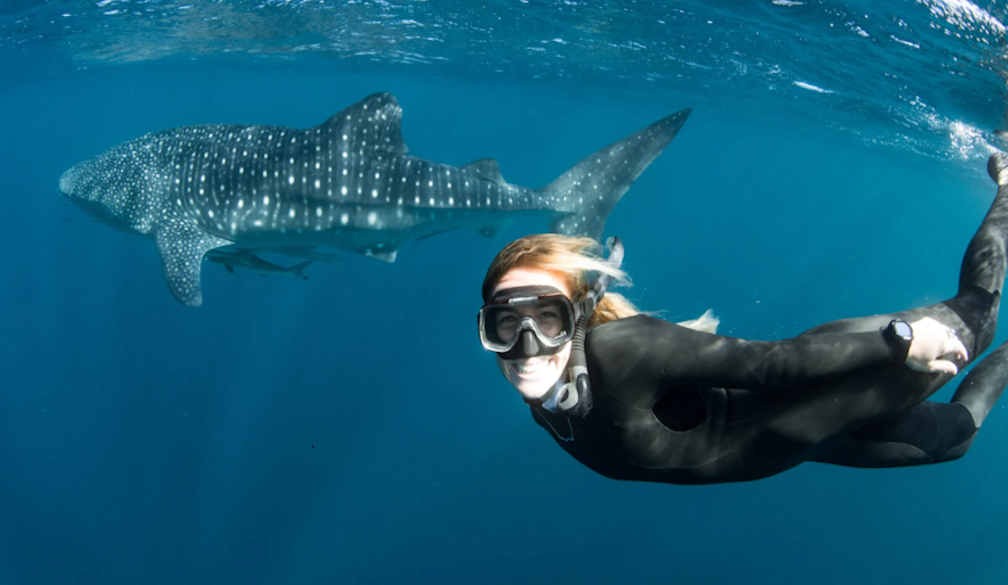
There are moments in life that divide time into before and after. Swimming alongside a whale shark at Ningaloo Reef is one of them.
The world's largest fish glides past at a pace that seems impossible for something so enormous. Up close, the scale is staggering: a creature that can reach 12 metres in length and weigh up to 20 tonnes, moving through crystalline water with a slow, effortless sweep of its tail. You don't feel fear. You feel something closer to reverence.
Exmouth, on Western Australia's remote Coral Coast, is where this encounter happens more reliably than anywhere else on earth. Every year, whale sharks gather at the World Heritage-listed Ningaloo Marine Park in numbers that have made this stretch of coastline the global benchmark for ethical, up-close whale shark swimming. Nearly 40,000 visitors made the journey to Exmouth and Coral Bay in a single recent season to experience it.
This article is about the experience itself: the creature, the reef, the moment you slip into the water and realise you're sharing it with something ancient and extraordinary.
If you're looking for pricing, inclusions, and practical tour details, our Whale Shark Tours Exmouth Ultimate Guide covers all of that. What follows is the story of the encounter itself.
The Whale Shark: Earth's Gentle Giant
Before you can truly appreciate swimming with a whale shark, it helps to understand what you're actually swimming with. The reality is far more fascinating than the name suggests.
A fish, not a whale
The whale shark (Rhincodon typus) is a fish, not a mammal. It breathes through gills, not lungs. The "whale" in its name refers purely to its size. It is, in fact, the largest living fish on the planet, the largest shark that has ever existed, and the only member of its family, Rhincodontidae.
Key facts about the whale shark:
|
Attribute |
Detail |
|
Scientific name |
Rhincodon typus |
|
Maximum length |
Up to 18-20 metres |
|
Average length |
Around 12 metres |
|
Weight |
Up to 20 tonnes |
|
Lifespan |
Estimated up to 100 years |
|
Diet |
Filter feeder: krill, plankton, fish eggs |
|
Conservation status |
Endangered (IUCN Red List, 2016) |
|
Depth range |
Surface to over 1,500 metres |
Why they're not dangerous
This is the question almost everyone asks before their first swim. The answer is reassuring: whale sharks pose no threat to humans whatsoever. They are filter feeders, one of only three shark species that feed this way (alongside the basking shark and megamouth shark). Their mouths, which can be up to 1.5 metres wide, are designed to strain tiny organisms from the water, not to bite or chase prey.
They move slowly, typically at around 5 km/h, and are famously unbothered by the presence of snorkellers. The challenge on a swim isn't avoiding them; it's keeping up.
The mystery that makes them special
Despite being the world's largest fish, whale sharks remain deeply mysterious. Scientists have never witnessed a female whale shark give birth in the wild. Where they breed, where the pups spend their early years, and the full extent of their migration routes all remain largely unknown. Satellite tracking has followed individuals travelling thousands of kilometres to waters near Indonesia, Timor and Christmas Island, but what happens next is still being pieced together.
This is part of what makes every Ningaloo encounter so remarkable. You are swimming with a creature that science is still working to understand, in one of the few places on earth where it reliably appears.
Why Ningaloo Reef and Exmouth Are in a Class of Their Own
Whale sharks can be found in tropical waters across the globe, from the Philippines to Mexico to the Maldives. So what makes Ningaloo the destination that serious wildlife travellers consistently rate above all others?
The coral spawning trigger
The answer begins with biology. Each year, following Ningaloo Reef's annual mass coral spawning event, a vast plankton bloom erupts in the waters off Exmouth. This bloom is the equivalent of a dinner bell for whale sharks. Unique current systems along Western Australia's coast keep this food source concentrated close to shore, which is why the sharks appear in such reliable numbers and in such accessible, shallow water.
This isn't luck. It's a predictable ecological cycle that has been drawing whale sharks to this precise stretch of coastline for millennia, and it's the foundation on which Exmouth's entire whale shark tourism industry is built.
Shallow, clear, close to shore
Most whale shark destinations require long offshore journeys into deep, often choppy water. Ningaloo is different. The reef sits just off the coast, and the sharks feed in waters shallow enough to snorkel comfortably. Visibility is exceptional, often exceeding 20 metres, which means every moment in the water is vivid and immersive.
"What is known is that they regularly congregate at Ningaloo each year, and the World Heritage-listed Ningaloo Marine Park is one of the most reliable places on Earth to swim with the giant fish." — Tourism WA
A protected ecosystem, not just a destination
Ningaloo's status as a UNESCO World Heritage Site is not a marketing badge. It reflects genuine ecological significance: over 500 species of fish, 300 species of coral, and one of the world's last fringing reefs that remains in genuinely good health.
The WA government manages whale shark interactions through a strict licensing program. Only 11 tour operator licences are issued across the entire region. A maximum of 10 swimmers is permitted in the water with any single whale shark at any time. Since the program began in 1997, more than 1,770 individual whale sharks have been identified and catalogued in the park, contributing directly to global conservation science.
The result: Ningaloo is one of the most tightly managed and environmentally sustainable whale shark swim experiences anywhere in the world. Visiting here is not just a bucket-list tick; it actively funds the research that protects the species.
What It Actually Feels Like to Swim with a Whale Shark
No photograph fully prepares you for it. The scale, the silence, the slow-motion quality of the encounter: these things need to be experienced to be understood. But here's as close as words can get.
The approach
The spotter plane has located a shark. The crew positions the vessel ahead of its path, and you're in the water before you've had time to think too hard about it. The guide calls the entry: a controlled roll off the side of the boat, fins already on, mask already down.
For a few seconds, there's nothing but blue water and the sound of your own breathing through the snorkel. Then a shadow appears.
It grows. And grows. What looked like a dark shape in the distance resolves into something with a mouth the width of a doorway, a body covered in a constellation of white spots, and a tail fin taller than most people. It passes within metres. The water is so clear you can see every spot, every ridge of cartilage, every tiny fish riding in its slipstream.
Most guests describe the same reaction: the impulse to speak, immediately suppressed by the snorkel. The urge to reach out, held back by the guide's training. A sensation of time slowing down.
The swim itself
Whale sharks move at a deceptively fast pace. Guides instruct swimmers to stay alongside, not behind, to avoid the powerful tail wash and to maintain the required distance from the animal. The swim is active: fins working steadily, eyes wide, the reef scrolling past below.
A typical interaction lasts between three and eight minutes before the guide signals the group back to the boat for repositioning. Multiple swims are common on a full-day tour, and each one is different. Some sharks are curious and circle back. Others move on a straight, purposeful line. Every encounter has its own character.
What you'll almost certainly also see
Whale sharks are the headline act, but Ningaloo's waters are extraordinary in their own right. On a typical tour day, it's common to encounter:
- Manta rays: Ningaloo hosts both reef and oceanic manta rays, and encounters are frequent from late May onwards
- Humpback whales: Present from June through October, and sometimes visible from the boat during whale shark swims
- Sea turtles: Green and loggerhead turtles are resident on the reef year-round
- Reef fish: Over 500 species, from parrotfish and angelfish to tawny nurse sharks and reef sharks
- Dolphins: Commonly seen riding the bow wave as the vessel heads to and from the swim site
- Dugongs: Occasionally spotted grazing in seagrass beds along the coast
The whale shark swim is the centrepiece, but the reef snorkels between swims are genuinely spectacular in their own right. Ningaloo's coral gardens are among the healthiest accessible reef systems anywhere in the Southern Hemisphere.
When to Go: The Ningaloo Whale Shark Season
The whale shark season at Exmouth runs from early March through to early October each year, with the peak months delivering the highest frequency of sightings and the warmest water temperatures.
Season at a glance
- March to August (peak season): The core whale shark season, when sightings are most frequent and reliable. Water temperatures are warm to mild, and the sharks are feeding actively following the coral spawning bloom. This is the period most visitors target.
- June to October (humpback overlap): Humpback whales arrive from June, creating the extraordinary possibility of encountering both species in the same day. Ningaloo is one of very few places on earth where this is possible.
- September to October (shoulder season): Sightings become less frequent but the experience is quieter and less crowded. The Australian Institute of Marine Science notes that whale sharks can be found in Ningaloo waters through to July before most individuals move on, though some linger into the shoulder months.
Who can do it
One of the most common misconceptions about whale shark swimming is that it requires diving experience or strong swimming ability. It doesn't. Snorkelling is the method used on all tours, and guides and flotation aids are provided for guests who want extra support in the water.
There are no age restrictions for whale shark swims. Children and older adults swim alongside whale sharks every day of the season. The water is calm, the sharks are slow, and the guides are trained to keep every guest comfortable.
For guests who prefer not to enter the water, observer spots on the boat provide excellent viewing from above, with the clear water often making the sharks clearly visible from the deck.
The Spotter Plane Advantage: Why It Changes Everything
The single biggest variable on any whale shark tour is finding the animal. Whale sharks are wild creatures moving through open ocean; without a reliable method to locate them, a tour can become a long boat ride with a lot of hope attached.
Three Islands Whale Shark Dive is the only operator in Exmouth with a dedicated, professionally licensed spotter plane. This distinction is more significant than it might first appear.
How the spotter plane works
The aircraft takes to the skies before the vessel reaches the swim area. From altitude, whale sharks are remarkably visible in Ningaloo's clear, shallow water: their distinctive spotted pattern and size make them easy to identify from above. The pilot communicates directly with the crew, providing real-time positioning that allows the vessel to get ahead of the shark's path.
The result is more time in the water and less time searching. On a typical tour day, the plane can track multiple individuals across a wide area, giving the crew options that a boat-only operation simply doesn't have.
What this means in practice
- More swims per day: The crew can move between sharks efficiently, maximising the number of in-water encounters for guests
- Less crowding: Operating with advance knowledge of shark locations allows the vessel to work away from other boats, giving guests more space and a more personal experience
- Better positioning: Getting ahead of a shark, rather than chasing it, means calmer, more controlled water entries and better views
The spotter plane isn't just a logistical tool. It's the reason Three Islands consistently delivers multiple whale shark swims per tour rather than one rushed encounter. For a once-in-a-lifetime experience, that difference is everything.
For a full breakdown of what's included in a Three Islands tour, including the spotter plane, marine biologist, catering and photography, see the Whale Shark Tours Exmouth guide.
Swimming with Whale Sharks and Conservation: Your Visit Makes a Difference
Whale sharks are listed as Endangered on the IUCN Red List, a status upgraded from Threatened in 2016 as global populations continued to decline. The threats they face: boat strikes, entanglement in fishing gear, plastic ingestion, and targeted hunting in parts of the world where they remain unprotected, are real and ongoing.
Ningaloo stands apart from most whale shark destinations precisely because of how seriously conservation is taken here. The WA Department of Primary Industries notes that whale sharks are fully protected in Western Australian waters under both the Wildlife Conservation Act 1950 and the Fish Resource Management Act 1994. It is an offence to disturb, harm, or fish for whale sharks in any way.
How your tour contributes
Every whale shark tour booked with a licensed Ningaloo operator includes a marine park fee and whale shark conservation levy. These funds go directly to:
- Ongoing photo-identification research that tracks individual sharks across seasons and years
- Satellite tagging programs that map migration routes and feeding behaviour
- Population monitoring that informs management decisions at both state and international levels
- Data collection that contributes to global conservation science through institutions including the Australian Institute of Marine Science
Put simply: booking a whale shark tour at Ningaloo is one of the most direct ways a traveller can contribute financially to the protection of an endangered species. The $11.6 million spent annually by tourists swimming with whale sharks at Ningaloo funds research and management that benefits the species globally, not just locally.
The encounter is unforgettable. The contribution is lasting.
Ready to Book Your Whale Shark Swim?
There are very few wildlife encounters on earth that match swimming with a whale shark at Ningaloo Reef. The combination of scale, accessibility, ecological integrity, and sheer improbability of the moment makes it genuinely unlike anything else.
Three Islands Whale Shark Dive has been running tours from Exmouth since 1997, longer than any other operator in the region. The spotter plane, the marine biologist, the small group sizes, the professional photography: every element of the experience is designed to make the encounter as memorable and as meaningful as possible.
The season runs from March to October. Spots fill quickly, particularly during the peak months of April, May and June.
-
Call the team directly: 1800 138 501
The whale shark doesn't wait. Neither should you.
