

Press fit stainless steel pipe: The faster, safer alternative to welding
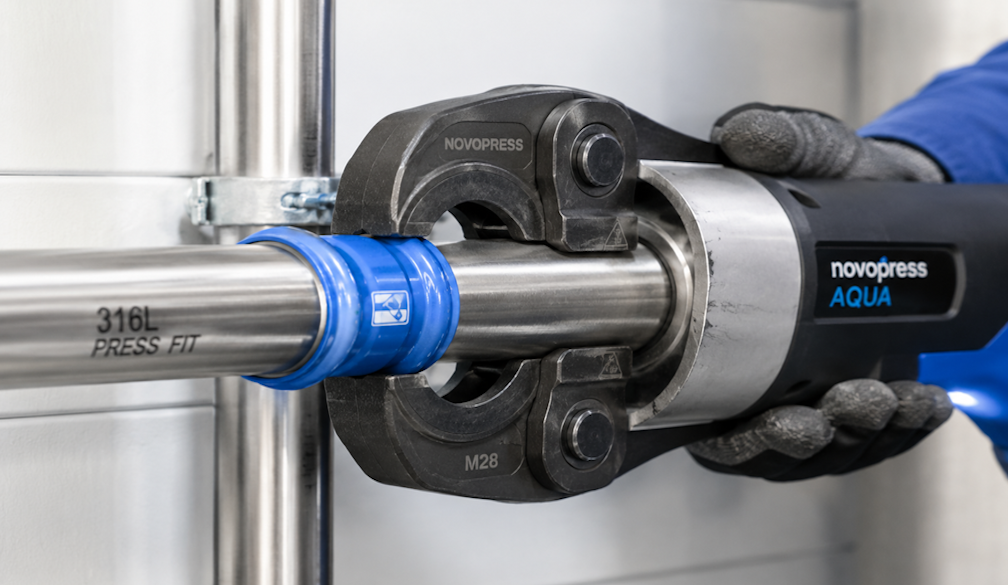
Welding has been the default jointing method for stainless steel pipework in commercial and industrial settings for generations. It produces a strong, permanent connection but it comes with significant downsides: it's slow, requires certified welders, creates a hot work environment with associated fire and explosion risks, and produces a heat-affected zone that can compromise the corrosion resistance of the stainless steel itself.
Press fit technology has changed the calculation significantly. For a growing range of applications, press-fit stainless steel pipe systems offer connections that are just as reliable as welded joints made in a fraction of the time, without any of the hazards of hot work. This article explores how press fit works, where it's most appropriate, and what to consider when specifying a system.
How press fit connections work
A press fit joint uses a specially designed fitting with an integrated sealing ring (typically EPDM or FKM, depending on the application). The pipe is inserted into the fitting, and a purpose-built hydraulic pressing tool is used to deform the fitting around the pipe, creating a permanent, leak-free mechanical connection.
The process takes seconds per joint, requires no flame, no filler material, no flux, and no post-weld treatment. Once pressed, the joint is ready for pressure testing immediately; there's no cooling time and no need for inspection of weld quality.
Systems designed for press fit stainless steel pipe applications are available across a full range of sizes and configurations, with fittings for straight runs, elbows, tees, reducers, and transitions to other pipe materials.
Applications where press fit excels
Press fit is particularly well-suited to applications where speed, cleanliness, and safety are priorities:
- Food and beverage processing — no contamination risk from welding fumes or flux; hygienic joints that are easy to inspect
- Pharmaceutical and medical gas systems — clean installations with no heat-affected zones that could affect material integrity
- HVAC and building services — fast installation in occupied buildings where hot work permits are difficult to obtain
- Industrial gas distribution — where eliminating ignition sources is critical
- Retrofit and upgrade projects — where welding in confined spaces or near existing services is impractical
In all of these settings, the ability to complete installations quickly, without hot work permits, and with a consistent, auditable joint quality is a major operational advantage.
Material grades and sealing options
Press fit stainless steel fittings are typically manufactured in 316L grade stainless steel, which offers excellent corrosion resistance across a wide range of media. This makes them suitable for both the pipe itself and the fluid or gas being conveyed.
The sealing ring material determines the compatibility of the system with different media:
- EPDM — suitable for water, steam, compressed air, and many industrial gases
- FKM (Viton) — for hydrocarbons, oils, and more aggressive chemical applications
- HNBR — for refrigerants and certain chemical applications
Specifying the correct seal type for the intended application is essential — incorrect seal selection is one of the most common causes of premature joint failure in press fit systems.
Comparing press fit to traditional jointing methods
When evaluating press fit joining systems against alternatives, the comparison looks different depending on the application, but some general observations hold:
Against welding: press fit is significantly faster (typically 5–10x), eliminates hot work risk, doesn't require a certified welder, and produces a consistent joint quality that doesn't depend on operator skill. The trade-off is that press fit fittings are more expensive per joint than weld preparations, but labour savings typically more than compensate.
Against compression fittings: press fit joints are generally considered more reliable under vibration and thermal cycling. They're also faster to make and more compact.
Against threaded joints: press fit eliminates thread sealing compounds, reduces leak points, and is much faster in stainless steel, where threading is difficult and expensive.
Installation requirements and quality assurance
Press fit systems require a specific pressing tool matched to the fitting series being used. Most manufacturers offer tool hire or sale arrangements, and the investment in a pressing tool pays back quickly on any project of scale.
Before pressurising a system, all joints should be visually inspected to confirm that the press has been completed. Most modern fittings include a visual indicator (often a viewing window or marked ring) that confirms proper engagement. Any unpressed joints can be detected during a pre-commissioning walk-through.
As with any pipework, system pressure testing to the appropriate standard should be completed before handover, and records maintained.
Conclusion
Press fit stainless steel pipe systems have earned their place as the preferred jointing method for a wide range of applications in Australia. The combination of speed, safety, cleanliness, and consistency makes them a compelling alternative to welding in almost every setting where hot work is undesirable or impractical.
For project managers, maintenance engineers, and specification writers, the decision to specify press fit is increasingly straightforward: the technology is mature, the product range is comprehensive, and the performance record is strong.
