

4 Engineering Project Management Strategies for Sustainable Growth
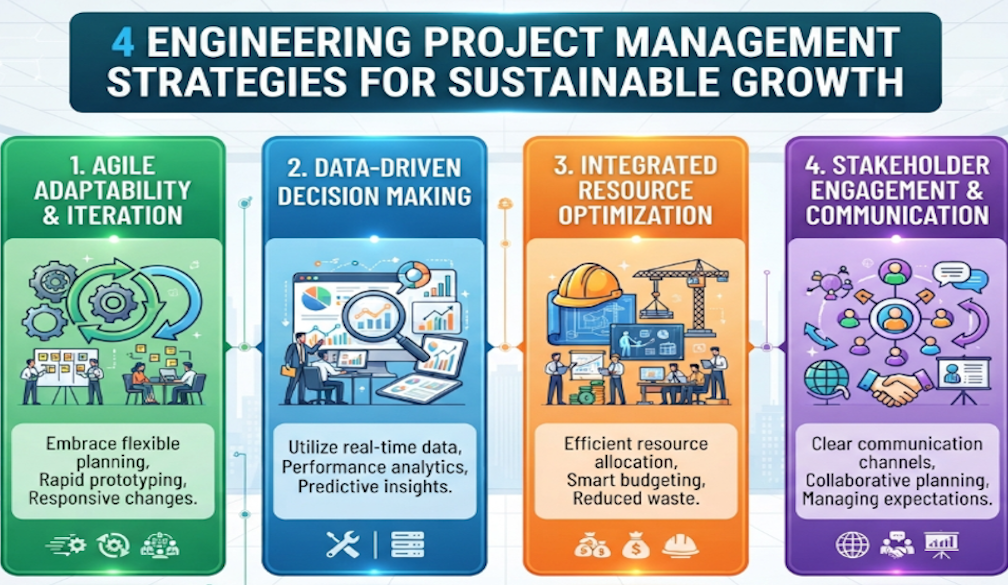
Engineering organizations face mounting pressure to deliver projects that drive both immediate results and lasting value. Yet many teams struggle to balance tight deadlines with strategic objectives, often sacrificing long-term stability for short-term wins. The gap between project execution and sustainable growth continues to widen across industries, leaving leaders searching for practical solutions. Four proven strategies can bridge this divide, transforming how engineering teams plan, execute, and scale their operations for measurable business impact.
Understanding the Link Between Project Management and Sustainable Growth
While engineering projects traditionally focus on technical deliverables and budget constraints, their true value increasingly lies in their contribution to long-term organizational viability.
Effective project management serves as the bridge between immediate execution and sustained competitive advantage. Organizations that integrate sustainability metrics into project frameworks experience improved resource allocation, reduced operational waste, and enhanced stakeholder confidence.
The connection manifests through three critical dimensions: environmental stewardship through optimized material usage, economic resilience via risk mitigation strategies, and social responsibility through community impact assessments.
Project managers who adopt this holistic approach transform initiatives from isolated tasks into strategic investments. This shift requires embedding sustainability criteria into project selection, monitoring performance against environmental and social benchmarks, and measuring outcomes beyond conventional success metrics.
Aligning Engineering Projects With Long-Term Business Goals
Strategic alignment transforms engineering projects from tactical executions into instruments of organizational advancement. Project managers must establish clear connections between technical deliverables and strategic objectives through thorough planning frameworks. This requires analyzing market trends, competitive positioning, and organizational capabilities before initiating projects.
Effective alignment demands continuous stakeholder engagement to guarantee project outcomes and support evolving business priorities. Key performance indicators should measure both technical success and strategic contribution, tracking metrics like market share growth, operational efficiency gains, and innovation advancement.
Cross-functional collaboration strengthens alignment by integrating perspectives from finance, operations, and executive leadership. Regular portfolio reviews enable teams to reallocate resources toward high-impact initiatives while discontinuing projects that no longer serve strategic purposes. This disciplined approach maximizes return on engineering investments and accelerates sustainable growth trajectories.
Using Project Management Software for Engineers to Improve Coordination
Modern project management software eliminates coordination bottlenecks that traditionally plague engineering teams working across disciplines and locations. These platforms centralize technical documentation, design specifications, and change orders in accessible repositories, preventing version control conflicts and miscommunication.
Project management software for engineers also enhances cross-functional collaboration by providing a unified environment where technical teams can monitor progress, manage risks, and coordinate complex project requirements.
Real-time collaboration features enable engineers to track dependencies between interconnected tasks, ensuring mechanical, electrical, and software components align throughout development cycles. Gantt charts and critical path analysis tools help project managers identify resource constraints before they impact deadlines. Automated notifications alert team members when upstream deliverables complete, triggering downstream activities without manual intervention.
Integration with CAD systems and testing environments creates seamless workflows from design through validation. Analytics dashboards provide visibility into project health metrics, enabling data-driven adjustments. This transparency helps engineering leaders optimize resource allocation and maintain delivery commitments.
Standardizing Planning Risk Management and Quality Control
Consistent frameworks for risk assessment and quality assurance prevent engineering projects from succumbing to predictable failure modes. Standardized templates identify potential hazards during initial planning phases, enabling teams to allocate resources toward mitigation strategies before issues escalate.
Risk registers document probability matrices, impact assessments, and contingency protocols that remain accessible throughout project lifecycles. Quality control standards establish measurable benchmarks for deliverables, ensuring compliance with industry regulations and client specifications. Regular audits verify adherence to predetermined criteria, while deviation tracking mechanisms trigger corrective actions.
Standardization eliminates ambiguity in acceptance criteria, reducing disputes between stakeholders and accelerating approval processes. Documentation protocols capture lessons learned, creating institutional knowledge that informs future projects. This systematic approach transforms reactive problem-solving into proactive risk management, ultimately reducing costs and protecting project timelines.
Optimizing Resources Budgets and Project Schedules
Effective resource allocation determines whether engineering projects deliver value within financial constraints and contractual deadlines. Project managers must balance personnel deployment, equipment utilization, and material procurement against budget limitations while maintaining schedule integrity.
Critical path method analysis identifies task dependencies and timeline bottlenecks, enabling managers to allocate resources where they generate maximum impact. Resource leveling prevents overallocation by distributing workload evenly across available capacity, reducing costs associated with overtime and expedited procurement.
Budget optimization requires continuous monitoring of actual versus planned expenditures, with variance analysis triggering corrective actions before overruns occur. Integrated scheduling tools synchronize resource availability with task sequences, ensuring materials and personnel arrive precisely when needed. Data-driven forecasting models predict resource demands across project phases, allowing proactive adjustments that maintain both schedule adherence and fiscal responsibility.
Measuring Performance and Learning From Completed Projects
While resource optimization focuses on executing projects according to plan, systematic evaluation of completed initiatives reveals whether planning assumptions matched reality and identifies patterns that improve future performance.
Project post-mortems examine schedule accuracy, budget adherence, and deliverable quality against original targets. Teams document deviations, root causes, and corrective actions that prevented or resolved issues. Key performance indicators quantify success metrics: cost variance, schedule performance index, defect rates, and stakeholder satisfaction scores. These measurements establish benchmarks for comparing projects and tracking organizational improvement over time.
Structured knowledge transfer captures technical solutions, vendor performance data, and lessons learned in accessible repositories. Engineering teams reference this institutional knowledge when scoping similar initiatives, avoiding repeated mistakes while replicating proven approaches. Regular retrospectives transform project experience into competitive advantage.
Building a Scalable Project Management Framework for Future Growth
As organizations expand their engineering portfolios, standardized processes must accommodate increasing project complexity without creating bureaucratic overhead. A scalable framework requires modular components that teams can adapt based on project size and risk profile. Core elements include standardized templates for documentation, repeatable workflows for common activities, and automated tools for routine tasks like status reporting and resource allocation.
The framework should establish clear escalation paths and decision-making authority at different organizational levels. Technology infrastructure must support collaboration across distributed teams while maintaining data integrity and security.
Regular framework assessments identify bottlenecks and opportunities for streamlining. Organizations should document best practices in accessible knowledge repositories, enabling new team members to onboard efficiently. Investment in training guarantees consistent methodology application across all projects, maintaining quality standards during rapid growth.
