

Timber Cladding: The Complete Guide to Choosing, Specifying, and Installing Timber for Exterior and Interior Applications
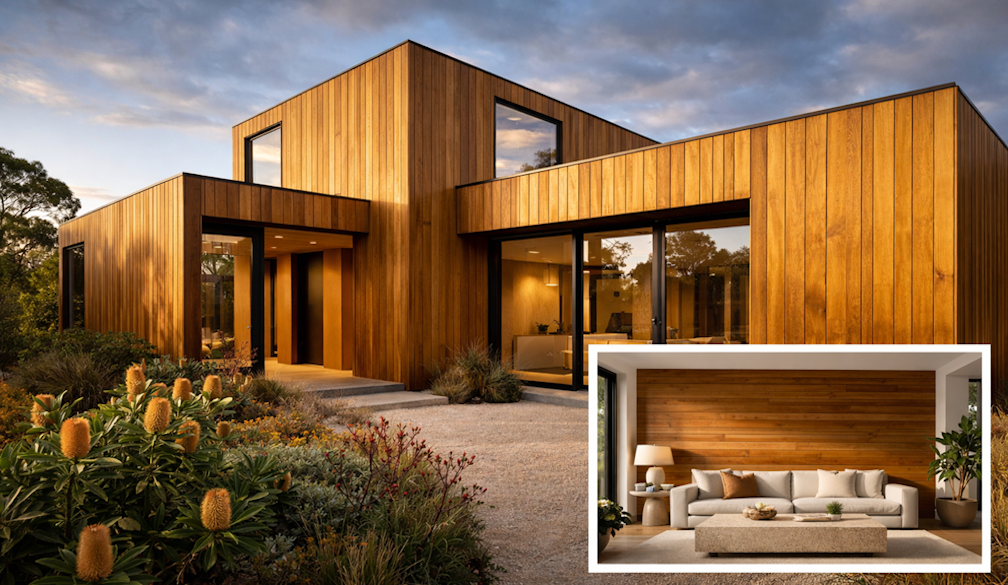
No building material carries quite the same combination of warmth, character, and design versatility as timber. It is one of humanity's oldest construction materials and, in the hands of a skilled designer, one of the most contemporary. Whether wrapping the exterior of a coastal home in weathered silver-grey boards, lining the interior of a restaurant in rich, oiled hardwood, or defining the facade of a new apartment building with bold vertical battens, timber cladding consistently produces results that feel both timeless and of the moment.
In Australia, timber cladding has experienced a significant revival over the past decade. Driven by a growing appetite for natural materials, a shift away from the rendered masonry boxes that dominated residential construction through the 2000s, and an increasingly sophisticated understanding of timber's genuine performance credentials, it is now firmly established as a first-choice material for architects, designers, and homeowners who want buildings that stand apart from the ordinary.
But timber cladding is a broad category, and making informed decisions within it — about species, profile, finish, installation system, and maintenance — requires more than aesthetic instinct. This guide covers the full picture: the performance case for timber cladding, the key differences between exterior and interior applications, how to choose species and profiles that suit your project, and the practical considerations that separate installations that look beautiful for decades from those that disappoint within years.
The Enduring Appeal of Timber as a Cladding Material
Before getting into the specifics of species and systems, it is worth understanding why timber continues to be chosen over the ever-expanding range of alternative cladding materials, fibre cement, metal, composite, and brick for projects where designers and clients are prepared to invest in quality.
Authenticity and Character
Timber is inherently variable. No two boards are identical; the grain patterns, colour variation, and natural character marks that occur in timber are the product of decades of growth in a specific environment. This variability is not a flaw; it is the quality that gives timber cladding its authenticity and visual richness. The eye moves across a timber-clad surface and finds endless detail to engage with, in a way that the uniform surface of a fibre cement sheet or metal panel simply cannot replicate.
This authenticity resonates particularly strongly in the Australian landscape. Timber buildings feel at home in the bush, at the coast, in the hills, and in urban environments where the warmth of natural material provides relief from the hard surfaces of the city. It is a material that connects buildings to their setting rather than imposing upon it.
Sustainability Credentials
Responsibly sourced timber is one of the most genuinely sustainable building materials available. Timber sequesters carbon throughout its growing life and continues to store that carbon when used in construction, in direct contrast to materials like steel, aluminium, and concrete, whose production is highly energy-intensive and carbon-emitting. For architects and homeowners with sustainability commitments, specifying certified timber cladding from responsibly managed forests is a meaningful and demonstrable contribution to a lower-carbon built environment.
Look for timber carrying Forest Stewardship Council (FSC) or Programme for the Endorsement of Forest Certification (PEFC) certification, these internationally recognised certification schemes provide assurance that the timber has been sourced from forests managed to environmental and social standards. Quality Australian timber suppliers can provide certification documentation on request.
Design Flexibility
The range of species, profiles, formats, and finishes available in the timber cladding market today is extraordinary. From narrow, fine-grained horizontal boards that create a calm, refined wall surface to bold vertical battens that emphasise building height and create dramatic light and shadow, from the silver-grey weathered patina of unfinished hardwood to the rich, oiled warmth of a freshly finished spotted gum, the design possibilities within the category of timber cladding are virtually limitless. This versatility is one of the material's greatest practical strengths.
Outdoor Timber Cladding: Performance Requirements and Species Selection
Exterior timber cladding is one of the most demanding applications for any building material. It must withstand UV radiation, rain, wind-driven moisture, temperature cycling, biological attack from fungi and insects, and in many Australian locations, the additional demands of salt air, extreme heat, or bushfire risk, often simultaneously. Getting the specification right is essential for an exterior timber cladding installation that performs as beautifully in year fifteen as it does in year one.
Natural Durability: Why Species Selection Matters
Australian Standards classify timber into durability classes (Class 1 through Class 4) based on their natural resistance to biological attack, the primary mechanism of timber degradation in exterior applications. For outdoor timber cladding, Class 1 or Class 2 species are recommended for most applications, as these timbers have sufficient natural durability to perform in exposed conditions without relying solely on applied preservative treatment.
Australian hardwoods dominate the top of the durability classification. Spotted gum, grey ironbark, turpentine, tallowwood, and river red gum are all Class 1 species, among the most naturally durable timbers in the world, and have been used in Australian exterior applications for generations with outstanding results. Blackbutt and brushbox are Class 2, offering excellent durability at a somewhat lower price point than the Class 1 species.
Imported species vary considerably in their natural durability. Western red cedar, one of the most widely used softwoods in exterior cladding internationally, is Class 2 to 3, performing reasonably well in exterior applications when properly finished and maintained. Accoya, a modified radiata pine treated with acetic anhydride to dramatically improve its durability and dimensional stability, offers Class 1 equivalent durability and is an increasingly popular option for architects seeking the workability and finishing characteristics of softwood with the durability performance of hardwood.
Moisture Management: The Key to Exterior Timber Performance
The single biggest driver of exterior timber cladding failure is poor moisture management, either in the design of the cladding system or in the maintenance of the finish that protects the timber from moisture ingress. Timber is a hygroscopic material that absorbs and releases moisture in response to changes in ambient humidity. This moisture cycling causes the dimensional movement, expansion when wet, contraction when dry, which stresses joints, finishes, and fixings over time.
Good exterior timber cladding design minimises moisture ingress and maximises drying conditions through:
- A well-ventilated cavity between the cladding and the building membrane, allowing moisture that does penetrate to escape rather than accumulate
- Board profiles that shed water effectively, profiles with a slight fall to the external face, or with a pronounced drip edge at the lower board face
- Back-priming or back-sealing of boards before installation, sealing the back face of each board, reduces differential moisture absorption between the exposed and sheltered faces, which is a primary cause of board cupping
- Careful detailing at junctions, window heads, sill flashings, roof-to-wall junctions, and base flashings are the most vulnerable points in any cladding system and deserve careful attention
- Appropriate finish selection and maintenance, penetrating oil finishes that allow moisture vapour to escape from the timber, typically outperform film-forming finishes in exterior applications over the long term
Bushfire Attack Level (BAL) Considerations
For projects in bushfire-prone areas, which describe a significant and growing proportion of Australian residential development, the cladding specification must account for the Bushfire Attack Level (BAL) rating of the site. Australian Standard AS 3959 specifies construction requirements for buildings in bushfire-prone areas, and the requirements for external wall cladding vary depending on the BAL rating from BAL-12.5 through to BAL-FZ (Flame Zone).
At lower BAL ratings (BAL-12.5 and BAL-19), many timber cladding products can be used with appropriate detailing. At higher BAL ratings (BAL-29, BAL-40, and BAL-FZ), the requirements become progressively more restrictive, and the use of combustible materials in the external cladding is significantly limited or prohibited. Always consult a bushfire consultant and verify the compliance of your proposed cladding specification with AS 3959 before proceeding on a BAL-rated site.
Interior Timber Cladding: A Different Set of Considerations
Interior timber cladding shares much of the aesthetic appeal of its exterior counterpart but operates in a fundamentally different performance environment. The absence of direct weather exposure removes many of the durability and moisture management challenges of exterior cladding, but introduces a different set of considerations around fire compliance, acoustic performance, humidity stability, and the interaction of the cladding with the interior environment.
Fire Compliance in Interior Applications
In commercial and multi-residential buildings, the use of interior timber cladding is governed by the fire performance requirements of the National Construction Code (NCC). Timber is a combustible material, and its use on internal wall surfaces is subject to requirements around the Spread-of-Flame Index (SFI) and Smoke-Developed Index (SDI) that vary depending on the building classification, the location of the cladding within the building, and the fire safety systems in place.
For residential buildings (Class 1 and Class 10 under the NCC), interior timber cladding is generally straightforward from a compliance perspective. For commercial buildings (Classes 2 through 9), the requirements are more complex and must be assessed on a project-by-project basis. Architects and designers specifying interior timber cladding in commercial applications should confirm compliance with their certifier early in the design process, and should request fire test data from their timber supplier where required.
Humidity and Acclimatisation
Interior environments, particularly in heated or air-conditioned spaces, can have significantly lower relative humidity than outdoor conditions, which causes timber to dry and contract. Solid timber boards installed without adequate acclimatisation, or in spaces with extreme humidity variation (such as saunas, swimming pool enclosures, or poorly insulated buildings in high-humidity climates), can develop significant checking, gapping, or distortion after installation.
Acclimatising timber boards to the humidity conditions of the installation space for a minimum of two weeks before fixing, and ideally longer, is essential for a stable installation. In spaces with very low humidity (below approximately 35% relative humidity), engineered timber products with stable substrates may be preferable to solid timber, as their dimensional stability under humidity variation is significantly better.
Species and Finish Options for Interior Use
The species range appropriate for interior cladding is broader than for exterior applications, as natural durability is not a primary consideration. This opens the door to beautiful species that may not perform adequately in exterior exposure, such as American walnut, European ash, and radiata pine, which offer exceptional aesthetic qualities and workability for interior applications.
Interior timber cladding finishes can also be more varied than exterior, where UV resistance and moisture repellency are primary requirements. For interior applications, hardwax oils, Danish oils, wax finishes, lacquers, and UV-cured coatings all have their appropriate applications depending on the species, the desired aesthetic, and the level of wear the surface will be subject to. Matte and low-sheen finishes are generally preferred in contemporary interior design for their natural appearance, while higher sheen finishes may suit more formal or traditional interior styles.
Profiles and Installation Systems: How the Detail Defines the Result
The profile of a timber cladding board and the installation system used to fix it are not merely technical decisions; they are design decisions that profoundly affect the visual character of the finished cladding.
Horizontal Board Profiles
Horizontal timber cladding profiles, including shiplap, bevel (or weatherboard), rebated, and shadowline, are among the most widely used in Australian residential architecture. They create a strong horizontal reading that emphasises the width of a building and connects to a long tradition of Australian weatherboard construction. The width of the boards, the depth of the shadow line between them, and the angle of the board face all affect the visual character of the installation, from fine and refined to bold and rustic.
Bevel profiles, where the board tapers from a thicker bottom edge to a thinner top edge, create the deepest shadow lines and the most pronounced horizontal emphasis. Shiplap profiles, where boards overlap with a flat face, create a flatter, more contemporary reading. Shadowline profiles with a distinct rebate between boards create crisp, clean lines that suit modern architectural styles particularly well.
Vertical and Diagonal Profiles
Vertical timber cladding, boards running from floor to ceiling or ground to soffit, creates an entirely different architectural expression than horizontal. It emphasises building height, creates a more formal and considered appearance, and can make a building seem taller and more slender. Vertical cladding also drains more effectively in exterior applications, as water runs down the face of the boards rather than across them, which can contribute to better long-term performance in very exposed locations.
Diagonal cladding, boards applied at 45 degrees, is less common but can create striking results on feature facades or accent walls where a bold departure from the conventional is intentional.
Battens and Open-Joint Systems
Timber batten cladding systems, where individual strips of timber are fixed with deliberate gaps between them, create a very contemporary aesthetic that blurs the boundary between cladding and screen. The gaps between battens introduce rhythm, allow glimpses of what lies behind, and create dynamic shadow patterns that change throughout the day as the sun moves. On exterior facades, open-joint batten systems require a weather-resistant membrane behind the battens to manage water ingress through the gaps.
Fixing Systems: Secret vs. Face Fixing
The method used to fix cladding boards to the building structure has a significant impact on the visual quality of the finished installation. Secret fixing systems, where fixings are concealed within the board joint and invisible from the face, produce the cleanest, most refined result and are strongly preferred for quality installations. Face fixing with visible nails or screws can look appropriate in certain rustic or industrial aesthetics, but generally reads as a lower-quality finish in contemporary residential and commercial work.
For exterior applications, all fixings should be stainless steel; galvanised fixings will corrode in contact with the tannins present in many hardwoods, and the resulting rust staining is both unsightly and difficult to remove.
Maintenance: Protecting Your Investment Over Time
Timber cladding is not a maintenance-free material, but with appropriate care, a well-specified and properly installed installation will perform beautifully for decades. Understanding what maintenance is required and building it into the life-cycle planning for the project is an important part of specifying timber cladding responsibly.
Exterior Maintenance
The primary maintenance requirement for exterior timber cladding is periodic re-application of the protective finish, whether oil, stain, or paint, to maintain the barrier that protects the timber from UV degradation and moisture ingress. The frequency of re-finishing depends on the exposure conditions, the species, the profile (which affects how quickly water is shed from the surface), and the type of finish used.
As a general guide, penetrating oil finishes on exposed exterior hardwood cladding typically require re-oiling every two to four years in full sun exposure, and every four to six years in more sheltered conditions. Film-forming finishes (paints and solid stains) generally require recoating every five to ten years, depending on quality and exposure. The manufacturer's recommendations for the specific finish product being used should always be followed.
Unfinished or minimally finished timber, such as cladding specified to weather naturally to a silver-grey patina, requires considerably less active maintenance, though periodic washing to remove biological growth (algae, mould) and inspection of fixings and joints remains important.
Interior Maintenance
Interior timber cladding requires considerably less maintenance than exterior. For oiled or waxed surfaces, periodic re-oiling or re-waxing, perhaps every two to five years, depending on traffic and exposure, maintains the appearance and protects the timber surface. Lacquered surfaces are more durable but more difficult to spot-repair when damaged. General cleaning with a damp cloth and pH-neutral cleaner is appropriate for most interior timber finishes.
Making the Right Cladding Choice for Your Project
Timber cladding is a category with enormous depth; the combinations of species, profile, finish, and installation system available today offer designers and homeowners creative freedom that is genuinely exciting. But that breadth of choice can also be overwhelming, and the consequences of a poorly considered specification, in both aesthetic and performance terms, are real.
The most important principles to hold onto through the selection process are these: match the natural durability of the species to the exposure conditions of the application; invest in quality installation including proper back-priming, appropriate fixings, and careful detailing at junctions; understand the maintenance requirements of the specification and commit to meeting them; and work with suppliers who can provide technical support and product documentation to back up their recommendations.
Done well, timber cladding, whether applied to the exterior of a home, a commercial building facade, or an interior feature wall, creates something genuinely special. It creates buildings and spaces that feel alive, that age with character and dignity, and that connect the people who inhabit them to the natural world in a way that no manufactured material can replicate. That is a rare quality, and it is entirely worth the care required to achieve it.
